Service bay
When to replace tires in Phoenix
Tread depth is the legal-looking number. Age, cracks, and uneven wear are the reasons a tire with tread left can still be finished in this climate.
Tread depth and the wear bars
Most passenger tires have wear indicator bars molded into the grooves at 2/32 of an inch. When the tread is flush with those bars, the tire is at the common legal minimum in many states and it is a poor tire in standing water. Do not wait for the bars if you can help it. Wet braking fades as the grooves shallow, and Phoenix rain, when it comes, is often a short dump on a dirty surface. Many drivers treat 4/32 of an inch as a practical point to plan a replacement before monsoon season rather than during it.
Measure in several grooves, not just the prettiest one, and compare inner and outer shoulders. A tread depth gauge is a small tool and more honest than a penny trick. Uneven depth is information: both shoulders low and the center high often points to underinflation; the reverse points to overinflation; one shoulder points to alignment or a worn suspension part. Fixing the cause is part of replacing the tire, or the new set copies the old wear. Pressure checks are in the pressure guide, and geometry is in the alignment guide.
Age and the date code
Find the DOT code on the sidewall. The last four digits are the week and year. A tire built in the 12th week of 2019 reads 1219. Tires age even in storage, and they age faster in heat and sunlight, which is the normal life of a tire in Phoenix. A widely used industry suggestion is to have tires inspected once they are about six years old and to replace them by about ten years from the build date, even with tread remaining. Desert parking is a reason to inspect earlier, not later. The heat guide explains why the calendar matters as much as the grooves.
Spare tires age too, including a full-size spare under a truck that has never been used. If you mount a ten-year-old spare for a weekend, you have mounted a ten-year-old tire. Check its date before you need it on a hot shoulder.
Cracks, bulges, and repairs that should not be reused
Weather checking looks like a fine network of cracks on the sidewall or between tread blocks. Light surface checking on an older tire is a prompt to inspect, not a decoration. Deep cracks, a bulge, a bubble, or exposed cord mean the tire is done. A bulge is a broken carcass, and heat plus speed is how that failure finishes. Do not ask a plug to solve it.
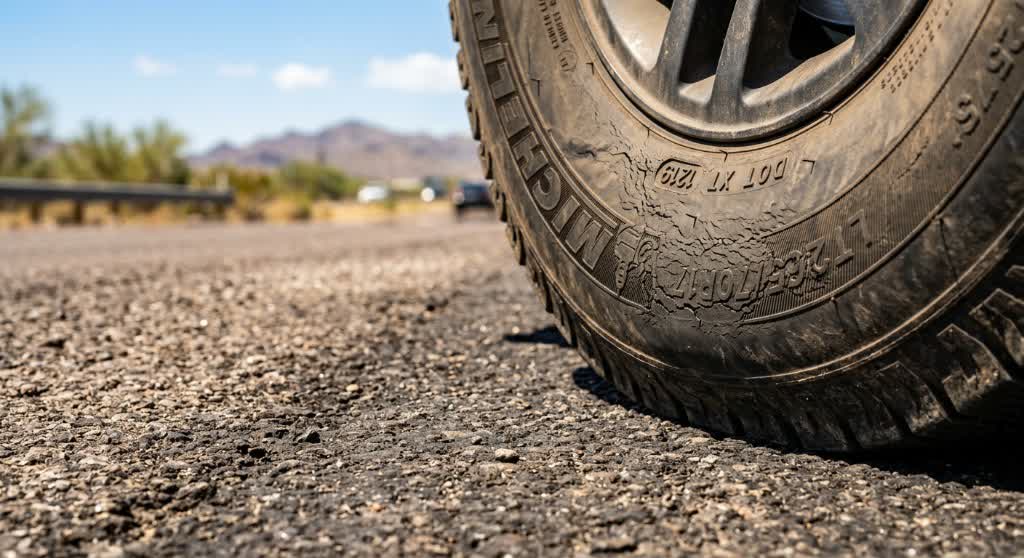
Punctures in the tread area can sometimes be repaired from the inside with a patch-plug combination, within the limits a reputable shop follows: not on the shoulder, not on the sidewall, not when the hole is too large, and not when the tire is already worn out. A string plug stabbed in from the outside on a gas-station apron is a temporary get-home measure at best. Sidewall damage from a curb on a narrow Phoenix parking row is usually a replacement, because the sidewall is the flexing part and it is thin on a low-profile tire.
Replace in pairs or in fours
Tires on the same axle should match in size, type, and, as closely as you can, in remaining depth. A new tire and a bald tire on the same axle brake differently in the wet. All-wheel-drive vehicles are more sensitive to diameter differences; check the owner's manual before you replace only one. If two tires are worn out and two are halfway, putting the new pair on the rear is the usual advice for a front-wheel or rear-wheel-drive car, because a rear tire that loses grip is harder for a driver to catch. Confirm that choice with the installer for your drivetrain.
Match the tread type to the miles you drive, and match the size to the placard or to a calculated alternative you understand. A replacement is also the moment people accidentally plus-size. If the new size is not identical, run it through the upsize calculator first.
Questions
The tread is at 5/32 but the sidewalls are cracked. Can I finish the year?
Treat cracks as a structural question, not a tread question. Have the tire inspected in person. Deep weather checking in this climate is a reason to replace even when the grooves still look usable.
How often should I look, if the tires are only a couple of years old?
A monthly pressure check is enough time to glance at sidewalls, nails, and odd wear. Add a more careful look before summer and before you leave the Valley on a highway trip.
Does rotation change the replacement date?
Rotation evens wear so you do not replace a set early because one position ate the tread. It does not change the build date. Keep rotating on the schedule in the manual, and still retire the set when age or damage says to.