Service bay
Wheel fitment: bolt pattern, offset, and bore
A tire can be the right size and still be mounted on a wheel the hub will not accept, or on a wheel that steers the tire into the fender. Fitment is the wheel's relationship to the hub, the brakes, and the body.
Bolt pattern is a match or it is not
The bolt pattern, or PCD, is the number of lug holes and the diameter of the circle they sit on. A pattern written 6x139.7 means six lugs on a 139.7 mm circle, which is the same circle as 6x5.5 inches. Five-lug passenger patterns such as 5x114.3 and 5x120 are common on crossovers. Six-lug patterns dominate many full-size trucks sold in Arizona. Eight-lug patterns show up on heavier three-quarter-ton and one-ton trucks.
Close is not usable. A 5x114.3 wheel does not belong on a 5x120 hub, even if someone can start the lugs. The studs would sit off-center in the holes, clamp unevenly, and be unsafe. Adapters exist in the aftermarket and add their own stack of thickness, hardware, and failure points. This guide does not treat an adapter as a normal fit. If the pattern does not match the hub, it is a different vehicle's wheel.
Center bore and hub-centric mounting
The center bore is the hole in the middle of the wheel. On a hub-centric wheel it slips onto a machined lip on the hub, so the wheel is centered by that lip before the lug nuts are tightened. The lugs then clamp the wheel; they are not what locates it. If the bore is smaller than the hub, the wheel will not seat. If the bore is larger, the wheel can be centered only by the lug nuts, which is lug-centric mounting.
Lug-centric wheels can be made to run true with the correct tapered or ball-seat nuts, but they are less forgiving. A plastic or aluminum hub ring fills the gap between a larger bore and a smaller hub so the wheel sits hub-centric again. The ring is a locator, not a load-bearing part. The lugs still provide the clamp. A ring that is the wrong diameter, cracked, or left out on a wheel that needs one is a classic cause of a vibration that shows up around freeway speed on the Loop 202 and disappears in a parking lot.
Offset decides where the tire stands
Offset is the distance, in millimeters, from the wheel's centerline to the mounting pad that touches the hub. Positive offset moves the mounting pad toward the street side of the centerline, which tucks the tire inboard, toward the suspension and the brakes. Negative offset moves the pad toward the inside of the wheel, which pushes the tire outboard, toward the fender lip. Zero offset puts the pad on the centerline.
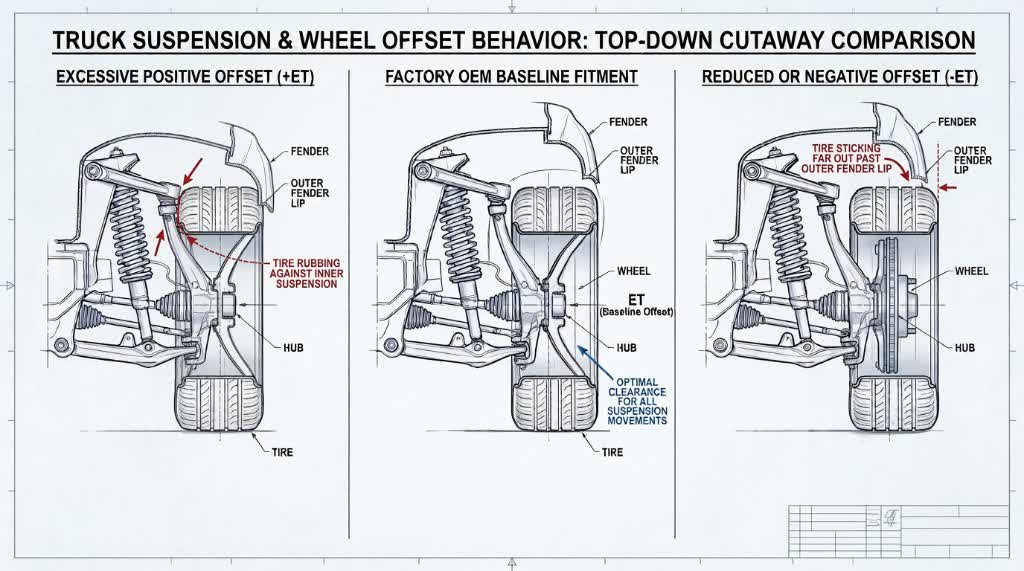
Factory wheels on a modern truck are often moderately positive so the tire clears the upper control arm and stays inside the fender. A wheel with much less positive offset, or a negative offset, sticks the tire out. That can look intentional and still rub the liner on compression, throw gravel down the side of the truck, and change scrub radius enough that the steering feels nervous on a grooved freeway. Too much positive offset does the opposite: the inner sidewall meets the spring, the shock, or the frame, and there may be no room for the caliper.
Width of the wheel changes the same geometry. A 9-inch-wide wheel with the same offset as an 8-inch wheel extends farther on both sides of the mounting pad. People often talk only about offset and then discover the extra inch of width was what hit the sway bar. Measure, or have a shop measure, backspacing if you are comparing a new wheel to the one on the truck. Backspacing is the distance from the mounting pad to the inner edge of the wheel and is another way of describing the same position.
Brakes, lugs, and the Phoenix habit of larger wheels
A larger wheel diameter is often chosen so a tire with a shorter sidewall keeps a similar overall height. That is plus-sizing, covered in the plus-sizing guide. The wheel still has to clear the brake caliper. A wheel that is the right bolt pattern and offset can still foul a caliper if its barrel or spoke shape was designed for a smaller brake. Cast markings and a seller's list of compatible vehicles are clues, not proof, because brake packages change inside a model year.
Lug nuts have a seat shape: cone, ball, or flat. The seat has to match the wheel. Using cone nuts on a wheel cut for ball seats, or leaving an extended shank nut on a hole that is too shallow, ruins the clamp. Thread pitch has to match the stud. Torque belongs at the specification for that vehicle, set with a torque wrench, and rechecked after the wheels have been driven and the clamps have settled. A shop that mounts tires should do this; it is still worth knowing, because an overtightened stud is a weekend problem you feel later as a broken stud on a hot shoulder.
After the wheels are on, the truck may need an alignment. Changing offset changes where the tire meets the road relative to the suspension pivots. Even a same-size replacement can sit differently if the old wheels were bent. Alloy and steel wheels take that abuse differently when a curb or a washed-out desert two-track hits the rim.
Questions
Can a wheel with the right bolt pattern still vibrate?
Yes. Bore, hub rings, bent inner barrels, unbalanced tires, and a seat style that does not match the lug nuts all produce vibration with a correct lug count. Center the wheel on the hub, then balance the tire.
Is more negative offset better for looks in a truck-heavy city?
It only pushes the tire outward. Clearance to the fender, the change in steering feel, and whether the tire stays covered by the body are the real constraints. Many Phoenix trucks that look flush have a carefully small change in offset, not an extreme one.
Do I need new tires if I only change offset?
Not if the tire size still matches the wheel width it is mounted on and still clears the truck. Offset does not change the tire's overall diameter. It changes where that diameter sits. Re-check balance and alignment after the swap.