Service bay
Highway, all-season, and all-terrain tires
Most miles in Phoenix are paved, fast, and hot. The right tread is the one that matches the miles you actually drive, not the miles in a photo of a trail.
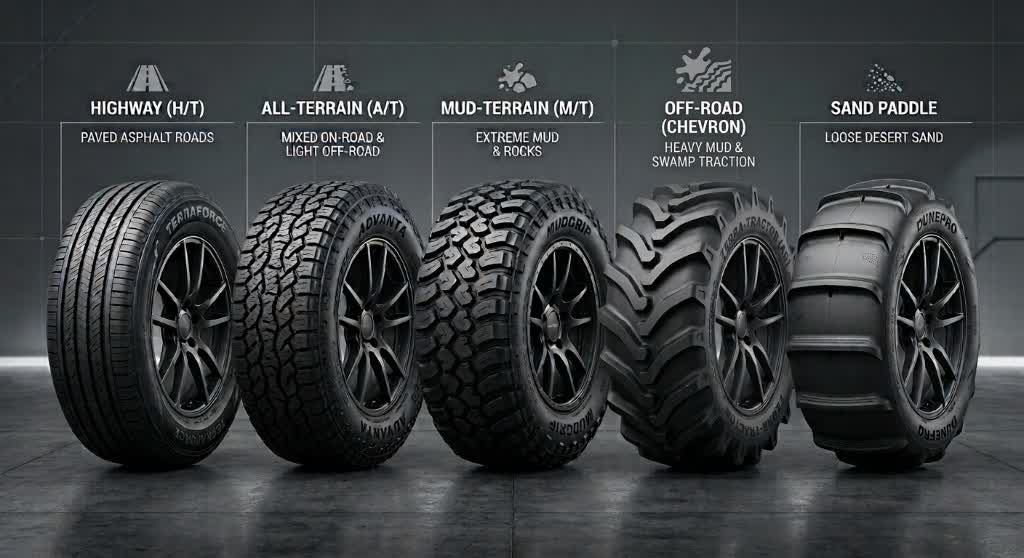
Highway-terrain is the pavement tire
A highway-terrain tire, often marked H/T, uses a continuous rib or a tight block pattern. It is aimed at quiet freeway running, even wear, and a long tread life on pavement. On I-10 and the Loop 101 that is most of the work: long, straight, hot miles with occasional heavy braking. The smaller grooves usually run cooler and quieter than an aggressive all-terrain. Wet performance depends on the specific compound and on remaining depth. A worn highway tire can still look tidy and hydroplane in the first minutes of a storm, when oil and dust are lifted off the surface and the rain is intense.
Highway tires are a poor match for repeated dirt, rock, and the sharp edges of a washed-out track. The tread blocks are not braced for that, and a puncture from a stone is more likely to end a Saturday than it is to end a commute. If your driving is pavement plus a smooth graded road a few times a year, a highway tire is often the honest choice.
All-season is the default compromise
All-season tires are what many crossovers and cars leave the factory on. They balance dry manners, light snow capability you will rarely use in the Valley, and wet braking. In Phoenix the snow part of the compromise is mostly unused, so you are paying for a tread that still has to work in a wide temperature band. That is acceptable. What you should still check is the heat story: load index, pressure, and age, as described in the heat guide. An all-season tire does not opt you out of sidewall cracks.
Some tires are sold as touring or grand-touring all-seasons with a focus on noise and wear. Those suit a sedan or a crossover that never leaves pavement. They are not a substitute for a light-truck rating if the door placard calls for one.
All-terrain is for mixed miles, and it has a cost
An all-terrain tire, A/T, opens the tread into larger blocks and wider voids so it can bite gravel, dirt, and the occasional muddy monsoon crossing. It is the common upgrade on trucks that split time between a job site and the freeway, or that take forest roads on weekends. The costs are real: more noise at 70 mph, often faster wear on pavement, and more heat in the tread blocks because they flex. A heavy all-terrain on a daily Loop 202 commute can be the wrong tool even if it looks right in a driveway.
Stronger all-terrain constructions, especially in LT load ranges, add puncture resistance and also add weight and a firmer ride. That weight matters in the heat because the tire and the wheel are rotating mass the brakes must stop. If you move to a larger, heavier package, revisit wheel material and plan on an alignment so the new tread does not saw itself down on a toe setting left over from the old tires.
Mud-terrain and the Valley commute
Mud-terrain tires are louder and usually worse on wet pavement than an all-terrain, with blocks spaced for mud that Phoenix sees only in bursts. They make sense for someone whose actual weekends are rocks and ruts, not for a truck that poses. On a rainy August evening the wide voids have less rubber on the road right when the freeway is slick. If that description is your week, step back to highway or all-terrain.
Choose from the miles you drive in a normal month. A single trail weekend does not automatically justify a mud-terrain set that will spend July on the freeway.
Whatever the tread, size still has to fit. An all-terrain advertised in a flotation size can be much taller than the tire on the placard. Check diameter with the calculator if you can express the size in metric numbers, and read plus-sizing before you accept a taller package as a style choice. Then judge remaining life with the replacement checks, because an open all-terrain tread hides wear differently than a ribbed highway tire.
Questions
Which tread is best for monsoon rain?
Depth and compound beat the marketing category. A fresh highway or all-season tire with open circumferential grooves often clears a brief downpour better than a worn all-terrain. Slow down in the first minutes of rain regardless of tread. Standing water in underpasses is a reason to turn around, not a reason to trust a sidewall.
Will an all-terrain last as long as a highway tire on pavement?
Often no. Larger blocks tend to wear faster and louder on hot freeway miles. Compare warranty miles only as a ceiling, then assume desert heat and alignment will matter as much as the number on the brochure.
Can I mix highway tires on the front and all-terrain on the rear?
Mixing tread types makes braking and wet grip inconsistent, and on all-wheel drive it can confuse the driveline if diameters also differ. Use one size and one type on the vehicle unless the manufacturer specifies a stagger.