Service bay
Plus-sizing without losing the original diameter
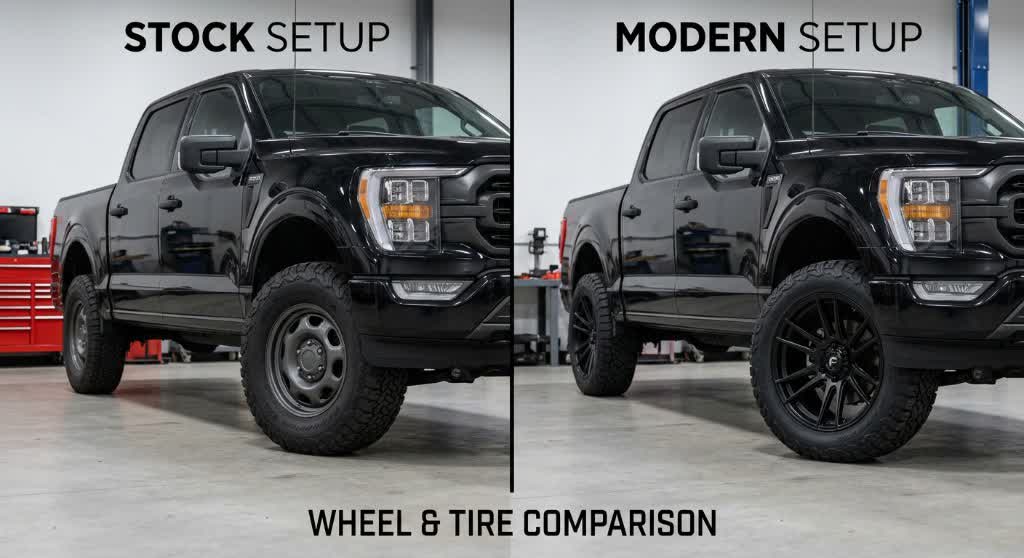
Plus-sizing puts a tire on a larger wheel while trying to keep the overall height the same. Done carefully, the speedometer, the gearing, and the fender gap stay familiar. Done by changing only one number, the truck gets taller or shorter than you meant.
What the plus number counts
Plus-one means a wheel one inch larger in diameter than stock, plus-two means two inches larger, and so on. A truck that came on 17-inch wheels moves to 18-inch wheels for a plus-one fitment. The sidewall has to shrink so the tire does not grow by that full inch. If you only increase the wheel and keep the same width and aspect ratio, overall diameter jumps by about 25.4 mm and the tire is no longer a plus-size in the careful sense. It is just a taller tire.
The usual compensation is a lower aspect ratio, sometimes with a slightly wider section. A 265/70R17 and a shorter, wider tire on an 18-inch wheel can land within a few millimeters of each other if the aspect drop is large enough. They can also miss by a wide margin. There is no universal conversion chart that is right for every original size. Calculate the original diameter, calculate the candidate, and subtract. That is the whole method, and it is what the upsize calculator automates.
Why diameter is the constraint
The speedometer and odometer assume the original revolutions per mile. A taller tire travels farther each time it rotates, so at an indicated 60 mph you are actually going faster, and the odometer under-reports distance. A shorter tire does the reverse: the speedometer reads high and the truck feels busier on the freeway because the engine turns more revolutions for the same road speed. Gear ratios and, on some vehicles, transmission shift logic were chosen around the original height. A small change is usually absorbed. A large one is something you should know about before you buy four tires.
A working rule of thumb is to keep the new overall diameter within about 3 percent of the original. That is not a law and it is not a guarantee of clearance. It is the band where speedometer error stays modest for most street trucks. Outside it, you should expect a visible error, a change in effective gearing, and a real chance that the tire meets the fender, the frame, or a crash bar. Three percent of an 803 mm tire is about 24 mm, roughly an inch. That is not much room once the suspension compresses over a dip on Thomas Road or the body rolls in a freeway lane change.
The 3 percent line is a screening tool. It does not measure your fenders. A tire inside 3 percent can still rub if offset or wheel width moved it into the liner.
A concrete pair
Start with 265/70R17, a common original size. Section width 265 mm, aspect 70, wheel 17 inches. Sidewall height is 185.5 mm. Overall diameter is 802.8 mm. Move to 285/70R17 and only the width changes. The new sidewall is 199.5 mm and the diameter is 830.8 mm. The tire is 28 mm taller, about 3.5 percent, which is already past the rule of thumb even though the wheel did not change. The speedometer will read a little low. Clearance above the tire and at the front of the fender on compression is the mechanical question the calculator cannot answer.
A true plus-one from that 17-inch tire would step to an 18-inch wheel and drop the aspect enough to give those 25.4 mm back. Whether 275/65R18 or some other candidate lands closer is arithmetic, not branding. Run both through the calculator. Then check that the new wheel's bolt pattern, offset, and bore match the hub, and that the tire's load index still covers the truck. Read the original numbers with the sidewall guide if the placard and the mounted tire disagree.
What else moves when the package changes
A shorter sidewall on a larger wheel usually sharpens response and transmits more of a broken pavement edge into the cabin. Phoenix streets accumulate cracks, raised lane markers, and the occasional washout after a monsoon. The ride change is the trade for the look and for a larger brake package that needed the extra wheel diameter. A taller, narrower tire does the opposite: more compliance, more sidewall flex in a quick lane change, and sometimes a vague feeling at freeway speed if the pressure is low.
Width changes the contact patch and the fit in the wheel well. A wider tire on the same wheel can square off the shoulder or stretch, depending on the wheel width. Tire makers publish a range of wheel widths for each tire size. Mounting a tire on a wheel outside that range is a reason a shop should refuse the job. It is also a reason an upsized truck that looks fine in a photo rubs the inner liner once it is loaded with people and a cooler for a drive out of town.
If the new diameter is intentional because you want ground clearance for dirt roads, say so and plan for the speedometer, the gearing, and the rubbing. That is a different project from plus-sizing. The highway and all-terrain comparison is about the tread you put on that package. The calculator still tells you the percent, which you should know even when you have decided to exceed it.
Questions
Does plus-sizing improve fuel economy in summer highway driving?
Not by itself. A larger wheel is often heavier, and a wider tire can add drag. Keeping the diameter close avoids a gearing change, which is about consistency, not a mileage gain. Heat, pressure, and alignment matter more to economy than the plus step.
Can I plus-size only the rear tires?
On a typical four-wheel Phoenix commuter, no. Different diameters on the same axle, or a large front-to-rear difference on an all-wheel-drive vehicle, can load the driveline. Match diameters across an axle. If the vehicle is all-wheel drive, keep all four very close unless the manufacturer allows a stagger.
The calculator says 2 percent. Is the tire guaranteed to fit?
No. Two percent only describes height. Offset, wheel width, and suspension travel decide whether that height hits the fender. Measure or have the clearance measured with the wheels straight and turned.